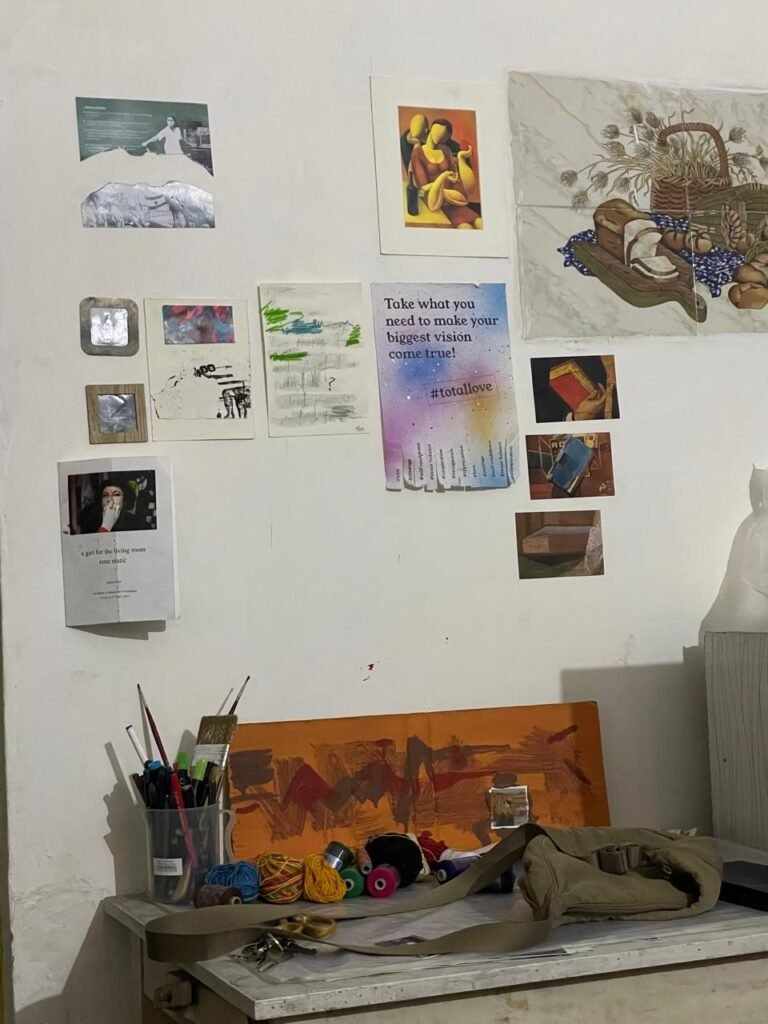
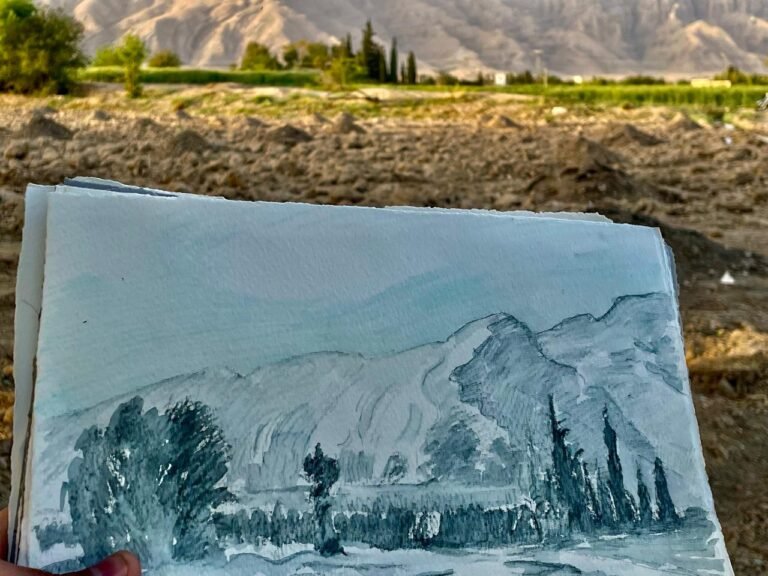
Niamat Nigaar (b. 1998, Loralai, Baluchistan) is a visual artist whose work is rooted in the landscapes of his hometown and his current base, Lahore, Pakistan. A graduate of the NCA, Lahore (2021), Niamat’s training as a painter has been profoundly shaped by his curiosity about the material world, and its origins. Growing up in Loralai, its land and its surrounding political dynamics have naturally informed his thought process and artistic direction. He engages in the collection of materials from his environment, incorporating them into his studio practice to explore their potential in new contexts.
Beyond exhibitions and residencies, and managing his studio in Lahore, Niamat remains deeply committed to his roots, conducting workshops and community-based projects in his hometown, fostering creative dialogue and empowerment through art.
Notes on community, materials, shared experience, & landscape
I learned that a workshop can be a collaboration. And a canvas can hold more than one voice.
You grew up shaped by Loralai’s landscape and its politics. Now that you’re based in Lahore, does the city ask something different of you than the land you grew up with did?
Loralai taught me to listen to the unsaid. The landscape there holds memories, the passage of time, ancient Silk Route marks in valleys. And the mountains do not forget. Nor do the people.
Lahore, on the other hand, is a city now. It asks for the presence of a certain kind of boldness. For showing up fully, even when you are still translating yourself from where you come from.
The two places do not cancel each other out. They converse inside me. And sometimes, that conversation is in itself, art.
You collect materials from your environment and bring them into the studio. What have you picked up from Loralai versus Lahore, and does the material carry the place with it?
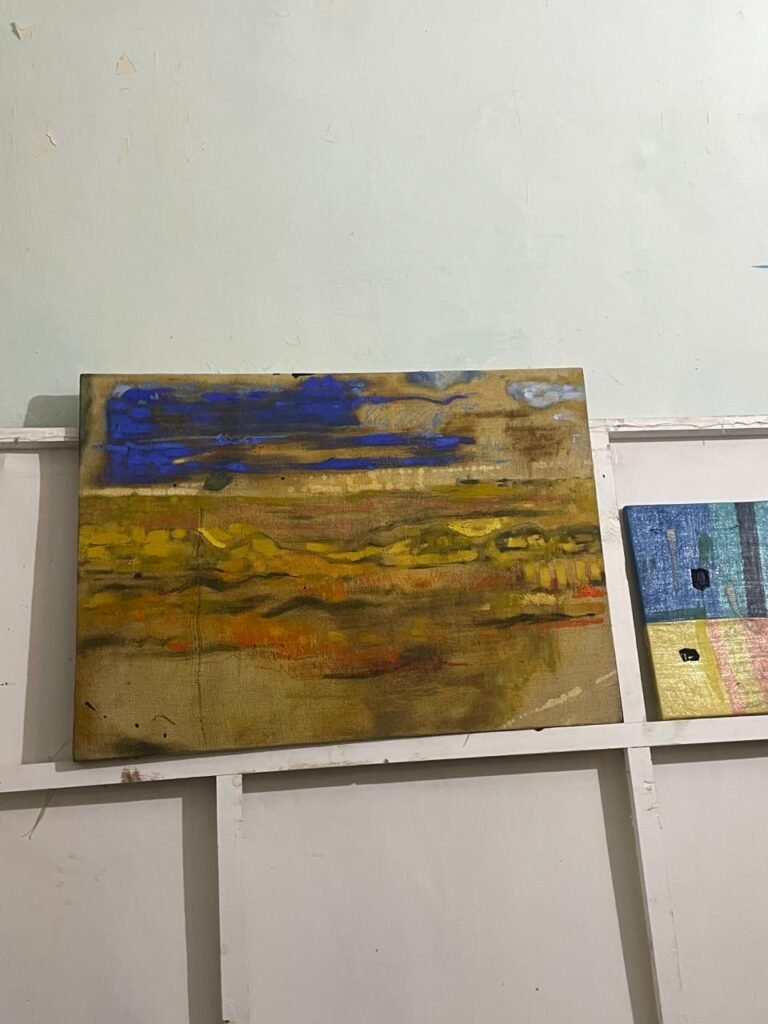
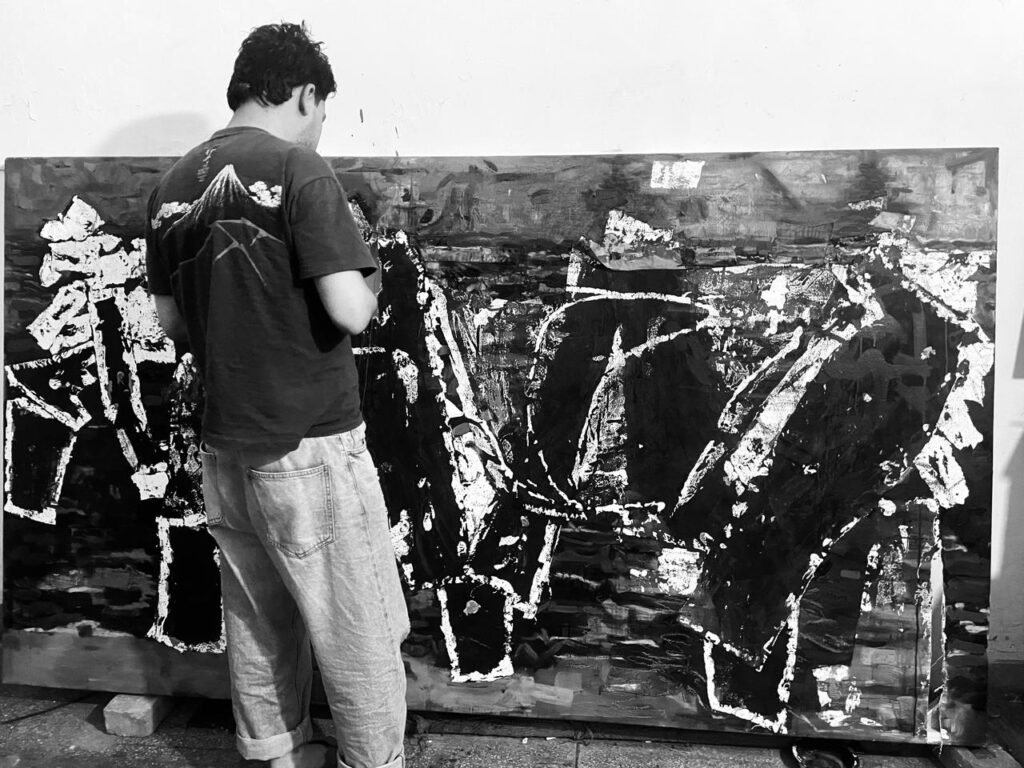
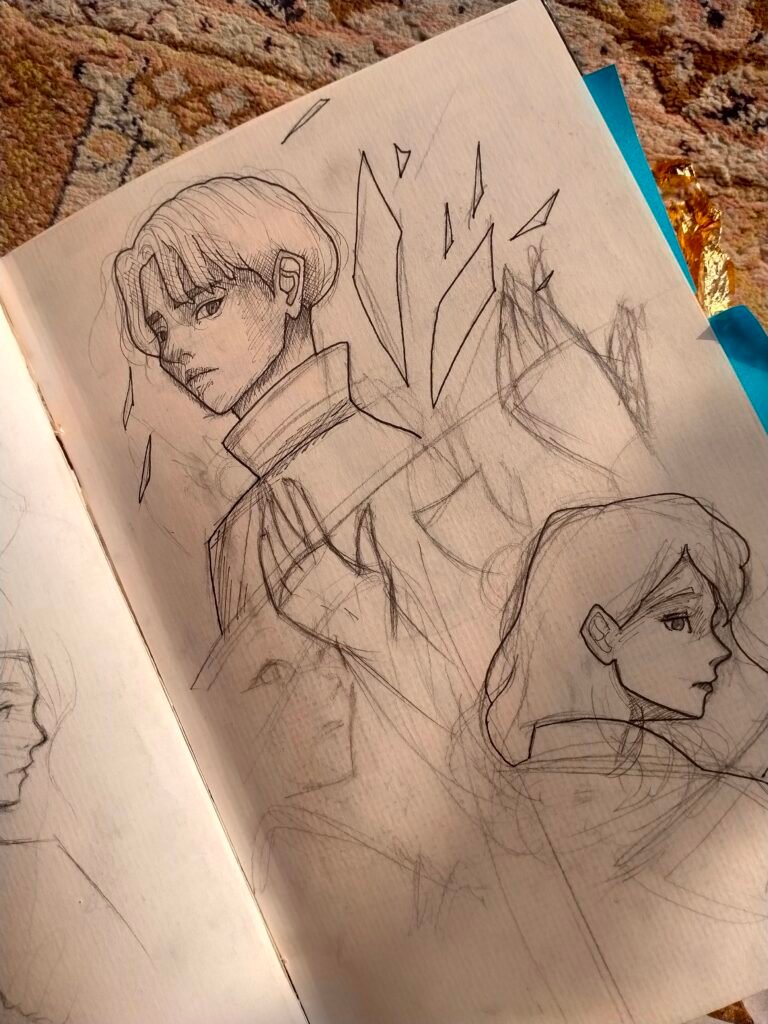
From Loralai, I first picked coal, raw from excavating mines. Jute bags that carried weight long before they carried meaning into my studio. But I didn’t just pick materials, I picked portraits. Every object I carry back is a portrait of a labourer and the community they involve in the mining. Their time, their evening gatherings, their joy in the darkness. I document. I take photographs. Some times draw them in pocket size sketch books before coming back to the canvas to paint a black circular triangular shape or a random mark on it.
From Lahore, the gathering is different. The materials shift is more industrial, maybe even more fleeting, but the instinct is the same. I still collect. I still witness. I still bring things back to the studio from ‘’Banso wala Bazar Lahore’’ and yes, the material carries the place’s regional origin.
Coal still hums with the mine. Jute still holds the weight of the partition and the echoes of trains to Lahore station. When I assemble them, I’m trying to enhance a new meaning to something that I was already living with. The studio becomes a meeting ground. A cold breeze from the mountains of Balochistan to laying in the hot urban pulse of Lahore. The decay of materials themselves. I always try to be faithful to what they carry.
Tell us about the workshops and community projects you’ve done in Loralai. What did they teach you as a person, and an artist?
Every year, we conduct a workshop in the remote areas of Baluchistan mostly community driven, focused on basic skills and beyond. Last year, I tried something more participatory and what emerged felt like a form of visual anthropology I never planned for. The students I worked with were underprivileged. And their drawings surprised me deeply. They weren’t the usual formulated drawings you see children do in schools: the standard house, the tree, the son going home. These were experiential drawings. Free. Fluent. Disrupted. Even harsh at times. There was no formula, just raw expression. That taught me something I carry into my practice now; that real drawing doesn’t need training, it needs truth.
Those participatory observations, the sketches, the texts they didn’t just stay in a notebook. They became part of my solo show at VM Art Gallery in Karachi. A painting not just by me but painted by, written by, shaped by an entire community.
I learned that a workshop can be a collaboration. And a canvas can hold more than one voice.
Which medium or colour has surprised you the most so far?
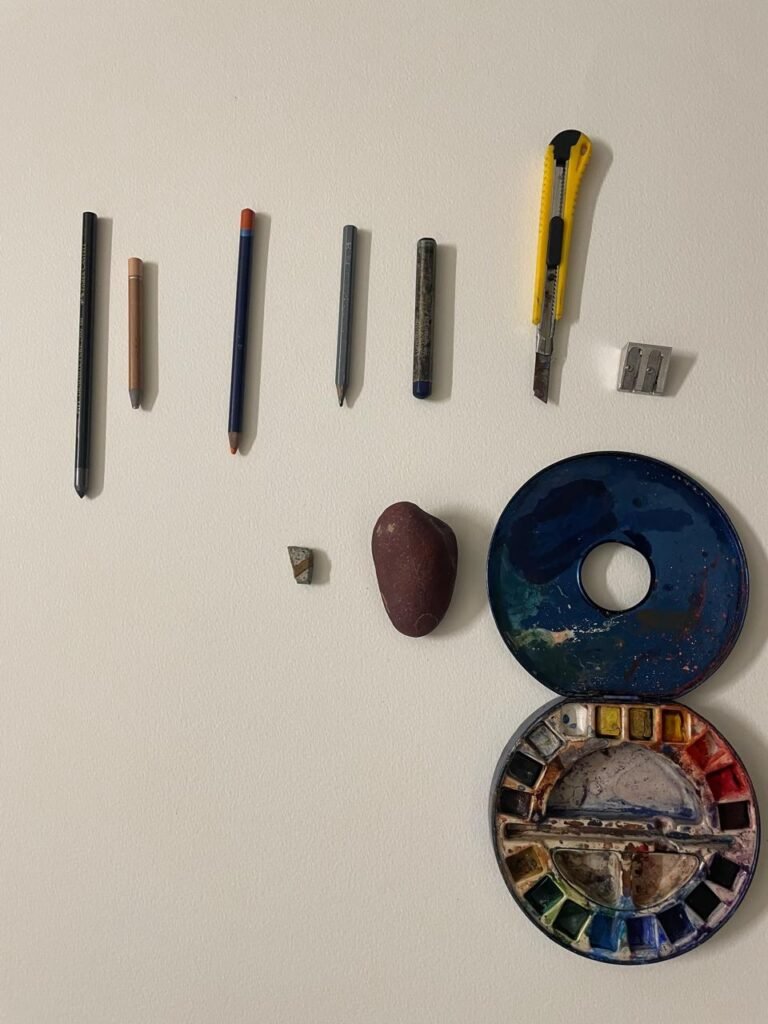
I mostly love raw materials. My favourite mediums are drawing tools, pencil colours, charcoal, oil sticks. Things that emulate the essence of a drawing, direct, quick, are unpolished. And so much more honestly.
But my favourite colour? Hmmmmn It’s not one. I love the intersection of colours the moment they merge, like during sunset, when one is becoming another. That in-between tones. Not red, not orange, not yet night
I like things in-between.
Stitching means different things to different people. Sometimes craft, sometimes tied to labour or gender. What does it mean to you?
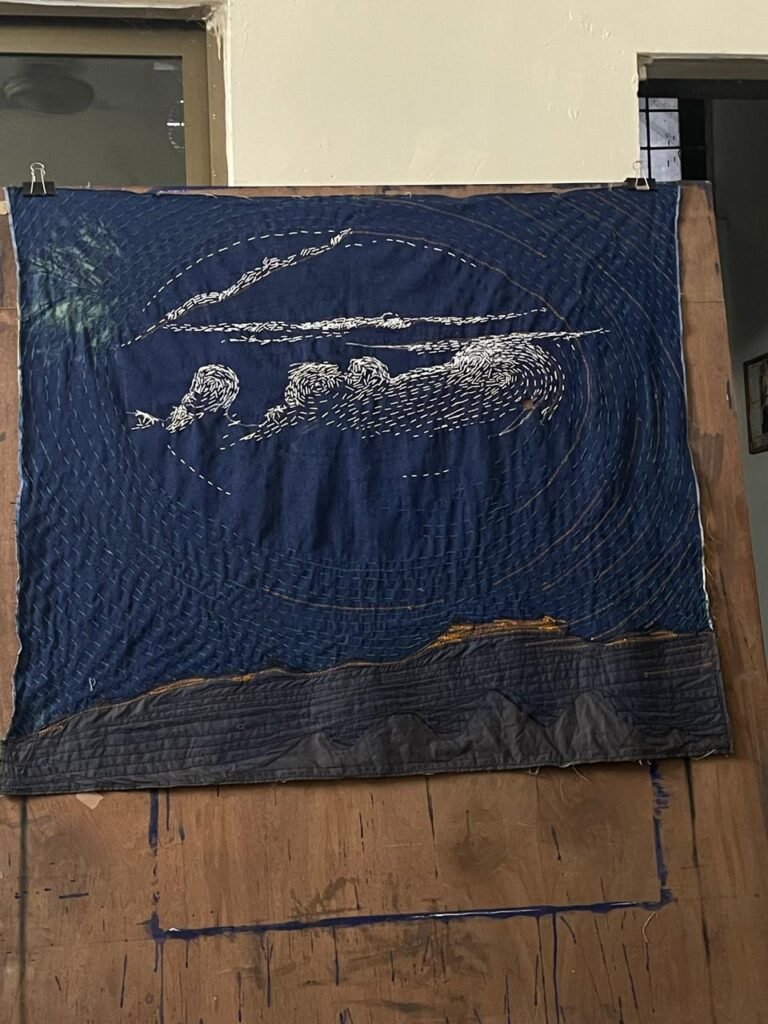
I love spontaneity while working on painting. As a painter, I do things randomly: a drawing on a surface, a line, a mark whatever comes. There’s no overthinking in that first move. Then comes the stitching which is the second layer. For me, stitching is a kind of meditation you do to stop thinking. After the major decisions on the surface are made, you just keep going. Doing and doing, thread after thread, until you reach the actual colour you wanted. Or the tiny detail you didn’t even know you were looking for.
So stitching, to me, isn’t about craft versus labour or even gender. It’s about rhythm. It’s quiet after the noise of the first gesture. Or it’s the last act to fix the marks on the surface some times many times any time….
You wrote that you’re not sure if moving between painting, photography, printmaking, and stitching is a limitation or the actual essence of your practice. What advice would you give another artist going through that same feeling, being pulled in too many directions early on?
Personally, I believe there is no formula in an artist studio. Many things happen at once. Some people create a certain type of painting and spend their whole zindagi doing that. That’s fine but I graduated from NCA, a liberal art institute. I’m still young and have a lot of energy to experiment.
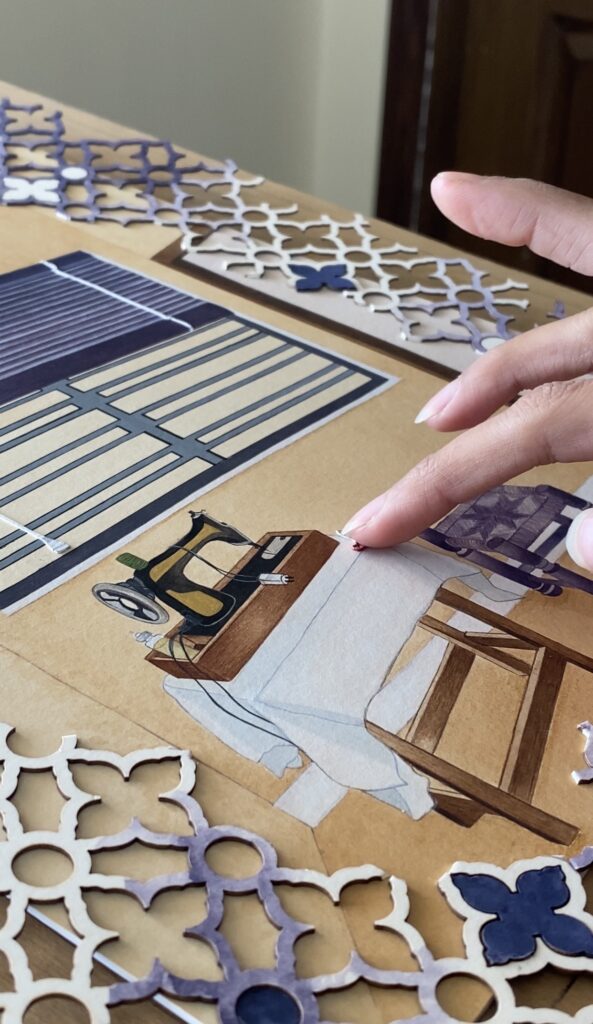
My advice to a young artist feeling pulled in too many directions? Keep experimenting as a young artist. Let your practice have two layers: one is your primary aspect, what you’re mostly expected to do or what you expect from yourself. The second is experimental; drawings, prints, photography, film, workshops, community work, empowerment through art. All of these are cool things to do. All of it feeds the primary. Especially when you are an abstract expressionist, the pictorial research really supports your abstraction come through, or inspired by. And over time, that experimentation won’t scatter you. It will place you.
What’s a way of painting, or a colour or material, you haven’t touched yet but keep thinking about?
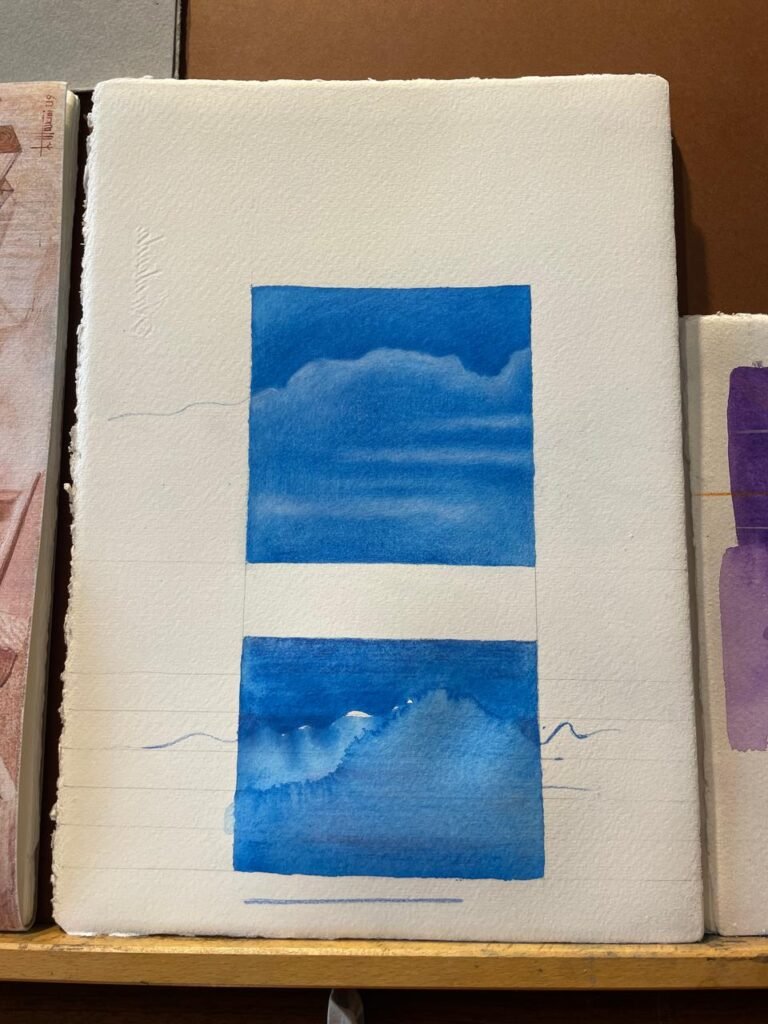
I really want to work with sounds I haven’t explored yet, but it keeps calling me. There is something about what the painting can’t hold, maybe sound can. And recently I am more interested in the sky, the clouds, their movement, shifting shapes, even perspective in the sky above the edge line of the mountains.